 Add to Chrome
 Add to Firefox
 Add to Edge
EvalVerse: Pipeline-Aware and Expert-Calibrated Benchmarking for Professional Cinematic Video Generation
May 22, 2026
The rapid evolution of generative video foundation models has propelled the field toward professional-grade cinematic synthesis. To achieve such demanding quality, the community transitions towards Reinforcement Learning (RL) and agentic workflows. However, reliable evaluation has emerged as a critical bottleneck. Existing benchmarks predominantly evaluate ''whether it is right'' (basic prompt-following) while fundamentally neglecting ''whether it is good'' (cinematic quality, acting, and aesthetics). Furthermore, current automated metrics lack the domain-specific rigor required to provide trustworthy signals, creating a severe credibility gap between human aesthetic perception and machine scoring. To bridge this gap, we introduce EvalVerse, a comprehensive, pipeline-aware, and expert-calibrated evaluation framework. We treat video generation assessment not merely as an engineering task, but as a core scientific problem: the systematic digitization of subjective cinematic expertise. First, we organize domain knowledge into an evaluation taxonomy aligned with the professional filmmaking workflow (pre-production, production, and post-production). Second, we distill human expert judgments into a curated dataset with large-scale human annotations. Third, we inject this knowledge into Vision-Language Models (VLMs) through an expert-calibrated fine-tuning strategy, enabling the VLM to perform explicit Chain-of-Thought reasoning. Compared to previous works, EvalVerse not only retains compatibility with foundational ''rightness'' metrics, but also significantly expands the criteria to ''goodness'' and broaden the task coverage to complex multi-shot sequencing and audio-visual integration. Consequently, by providing granular diagnostic signals, EvalVerse transcends a static leaderboard and establishes a fundamental infrastructure for future work, such as reward models and evaluator agent.

ROAR-3D: Routing Arbitrary Views for High-Fidelity 3D Generation
May 20, 2026Single-image-to-3D generative models can now produce high-quality geometry, yet conditioning on a single view inevitably introduces ambiguity about unseen regions. Multi-view conditioning can reduce this ambiguity, but existing methods either require fixed canonical viewpoints or rely on external reconstruction modules that impose heavy training costs and limit generation quality. We observe that pretrained single-view models already possess strong 2D-to-3D grounding that can be reused for multi-view conditioning. However, a closer analysis reveals that their conditioning mechanism entangles orientation control with geometry transfer, two functions that conflict when images from different viewpoints are naively combined. Based on this analysis, we propose ROAR-3D, a lightweight method that upgrades a pretrained single-view model to accept an arbitrary number of unposed images. A token-wise view router assigns each 3D latent token to its most relevant view, implicitly establishing 2D-to-3D correspondences without explicit pose input. A dual-stream attention design preserves the pretrained primary-view behavior while routing auxiliary views through a separate path dedicated to geometric enrichment. An orientation perturbation strategy ensures the auxiliary path learns orientation-independent geometry transfer. These components introduce minimal trainable parameters and add negligible inference overhead relative to the single-view baseline. ROAR-3D achieves state-of-the-art multi-view 3D generation quality and supports test-time view scaling from 1 to 12+ views with consistent improvements.
VistaGEN: Consistent Driving Video Generation with Fine-Grained Control Using Multiview Visual-Language Reasoning
Mar 30, 2026Driving video generation has achieved much progress in controllability, video resolution, and length, but fails to support fine-grained object-level controllability for diverse driving videos, while preserving the spatiotemporal consistency, especially in long video generation. In this paper, we present a new driving video generation technique, called VistaGEN, which enables fine-grained control of specific entities, including 3D objects, images, and text descriptions, while maintaining spatiotemporal consistency in long video sequences. Our key innovation is the incorporation of multiview visual-language reasoning into the long driving video generation. To this end, we inject visual-language features into a multiview video generator to enable fine-grained controllability. More importantly, we propose a multiview vision-language evaluator (MV-VLM) to intelligently and automatically evaluate spatiotemporal consistency of the generated content, thus formulating a novel generation-evaluation-regeneration closed-loop generation mechanism. This mechanism ensures high-quality, coherent outputs, facilitating the creation of complex and reliable driving scenarios. Besides, within the closed-loop generation, we introduce an object-level refinement module to refine the unsatisfied results evaluated from the MV-VLM and then feed them back to the video generator for regeneration. Extensive evaluation shows that our VistaGEN achieves diverse driving video generation results with fine-grained controllability, especially for long-tail objects, and much better spatiotemporal consistency than previous approaches.
Beyond VLM-Based Rewards: Diffusion-Native Latent Reward Modeling
Feb 11, 2026Preference optimization for diffusion and flow-matching models relies on reward functions that are both discriminatively robust and computationally efficient. Vision-Language Models (VLMs) have emerged as the primary reward provider, leveraging their rich multimodal priors to guide alignment. However, their computation and memory cost can be substantial, and optimizing a latent diffusion generator through a pixel-space reward introduces a domain mismatch that complicates alignment. In this paper, we propose DiNa-LRM, a diffusion-native latent reward model that formulates preference learning directly on noisy diffusion states. Our method introduces a noise-calibrated Thurstone likelihood with diffusion-noise-dependent uncertainty. DiNa-LRM leverages a pretrained latent diffusion backbone with a timestep-conditioned reward head, and supports inference-time noise ensembling, providing a diffusion-native mechanism for test-time scaling and robust rewarding. Across image alignment benchmarks, DiNa-LRM substantially outperforms existing diffusion-based reward baselines and achieves performance competitive with state-of-the-art VLMs at a fraction of the computational cost. In preference optimization, we demonstrate that DiNa-LRM improves preference optimization dynamics, enabling faster and more resource-efficient model alignment.
StructLayoutFormer:Conditional Structured Layout Generation via Structure Serialization and Disentanglement
Oct 30, 2025Structured layouts are preferable in many 2D visual contents (\eg, GUIs, webpages) since the structural information allows convenient layout editing. Computational frameworks can help create structured layouts but require heavy labor input. Existing data-driven approaches are effective in automatically generating fixed layouts but fail to produce layout structures. We present StructLayoutFormer, a novel Transformer-based approach for conditional structured layout generation. We use a structure serialization scheme to represent structured layouts as sequences. To better control the structures of generated layouts, we disentangle the structural information from the element placements. Our approach is the first data-driven approach that achieves conditional structured layout generation and produces realistic layout structures explicitly. We compare our approach with existing data-driven layout generation approaches by including post-processing for structure extraction. Extensive experiments have shown that our approach exceeds these baselines in conditional structured layout generation. We also demonstrate that our approach is effective in extracting and transferring layout structures. The code is publicly available at %\href{https://github.com/Teagrus/StructLayoutFormer} {https://github.com/Teagrus/StructLayoutFormer}.
PartHOI: Part-based Hand-Object Interaction Transfer via Generalized Cylinders
Apr 29, 2025Learning-based methods to understand and model hand-object interactions (HOI) require a large amount of high-quality HOI data. One way to create HOI data is to transfer hand poses from a source object to another based on the objects' geometry. However, current methods for transferring hand poses between objects rely on shape matching, limiting the ability to transfer poses across different categories due to differences in their shapes and sizes. We observe that HOI often involves specific semantic parts of objects, which often have more consistent shapes across categories. In addition, constructing size-invariant correspondences between these parts is important for cross-category transfer. Based on these insights, we introduce a novel method PartHOI for part-based HOI transfer. Using a generalized cylinder representation to parameterize an object parts' geometry, PartHOI establishes a robust geometric correspondence between object parts, and enables the transfer of contact points. Given the transferred points, we optimize a hand pose to fit the target object well. Qualitative and quantitative results demonstrate that our method can generalize HOI transfers well even for cross-category objects, and produce high-fidelity results that are superior to the existing methods.
SketchVideo: Sketch-based Video Generation and Editing
Mar 30, 2025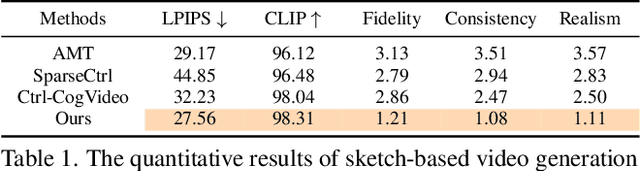
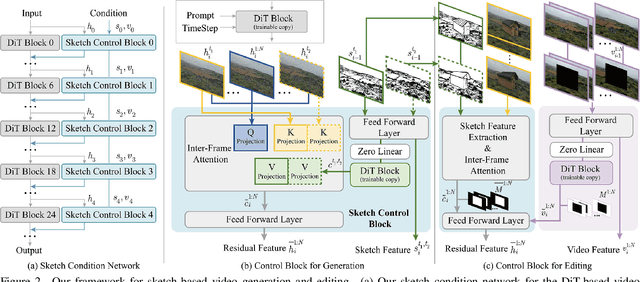
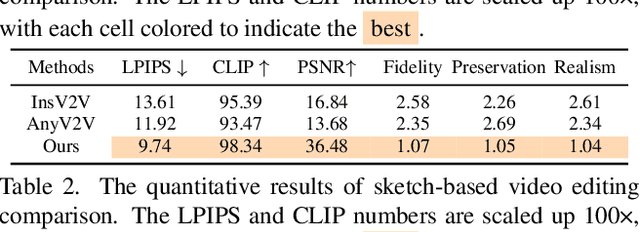
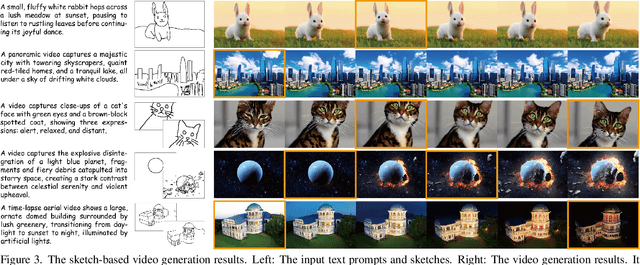
Video generation and editing conditioned on text prompts or images have undergone significant advancements. However, challenges remain in accurately controlling global layout and geometry details solely by texts, and supporting motion control and local modification through images. In this paper, we aim to achieve sketch-based spatial and motion control for video generation and support fine-grained editing of real or synthetic videos. Based on the DiT video generation model, we propose a memory-efficient control structure with sketch control blocks that predict residual features of skipped DiT blocks. Sketches are drawn on one or two keyframes (at arbitrary time points) for easy interaction. To propagate such temporally sparse sketch conditions across all frames, we propose an inter-frame attention mechanism to analyze the relationship between the keyframes and each video frame. For sketch-based video editing, we design an additional video insertion module that maintains consistency between the newly edited content and the original video's spatial feature and dynamic motion. During inference, we use latent fusion for the accurate preservation of unedited regions. Extensive experiments demonstrate that our SketchVideo achieves superior performance in controllable video generation and editing.
GCRayDiffusion: Pose-Free Surface Reconstruction via Geometric Consistent Ray Diffusion
Mar 28, 2025Accurate surface reconstruction from unposed images is crucial for efficient 3D object or scene creation. However, it remains challenging, particularly for the joint camera pose estimation. Previous approaches have achieved impressive pose-free surface reconstruction results in dense-view settings, but could easily fail for sparse-view scenarios without sufficient visual overlap. In this paper, we propose a new technique for pose-free surface reconstruction, which follows triplane-based signed distance field (SDF) learning but regularizes the learning by explicit points sampled from ray-based diffusion of camera pose estimation. Our key contribution is a novel Geometric Consistent Ray Diffusion model (GCRayDiffusion), where we represent camera poses as neural bundle rays and regress the distribution of noisy rays via a diffusion model. More importantly, we further condition the denoising process of RGRayDiffusion using the triplane-based SDF of the entire scene, which provides effective 3D consistent regularization to achieve multi-view consistent camera pose estimation. Finally, we incorporate RGRayDiffusion into the triplane-based SDF learning by introducing on-surface geometric regularization from the sampling points of the neural bundle rays, which leads to highly accurate pose-free surface reconstruction results even for sparse-view inputs. Extensive evaluations on public datasets show that our GCRayDiffusion achieves more accurate camera pose estimation than previous approaches, with geometrically more consistent surface reconstruction results, especially given sparse-view inputs.
Real-time 3D-aware Portrait Video Relighting
Oct 24, 2024Synthesizing realistic videos of talking faces under custom lighting conditions and viewing angles benefits various downstream applications like video conferencing. However, most existing relighting methods are either time-consuming or unable to adjust the viewpoints. In this paper, we present the first real-time 3D-aware method for relighting in-the-wild videos of talking faces based on Neural Radiance Fields (NeRF). Given an input portrait video, our method can synthesize talking faces under both novel views and novel lighting conditions with a photo-realistic and disentangled 3D representation. Specifically, we infer an albedo tri-plane, as well as a shading tri-plane based on a desired lighting condition for each video frame with fast dual-encoders. We also leverage a temporal consistency network to ensure smooth transitions and reduce flickering artifacts. Our method runs at 32.98 fps on consumer-level hardware and achieves state-of-the-art results in terms of reconstruction quality, lighting error, lighting instability, temporal consistency and inference speed. We demonstrate the effectiveness and interactivity of our method on various portrait videos with diverse lighting and viewing conditions.
Sketch2Human: Deep Human Generation with Disentangled Geometry and Appearance Control
Apr 24, 2024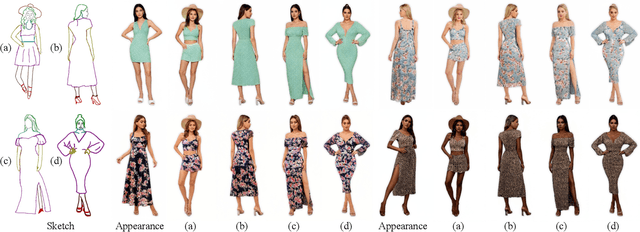
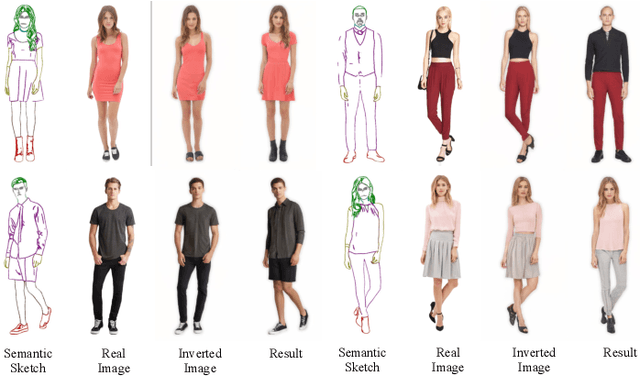
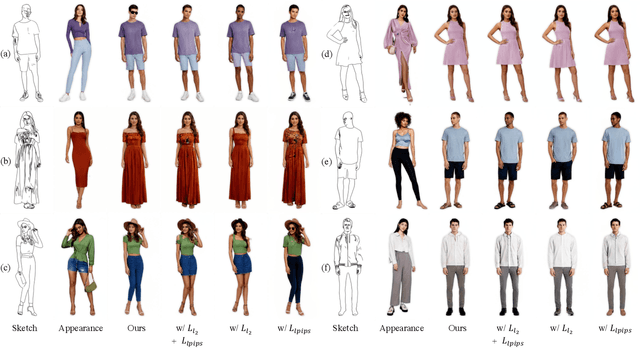
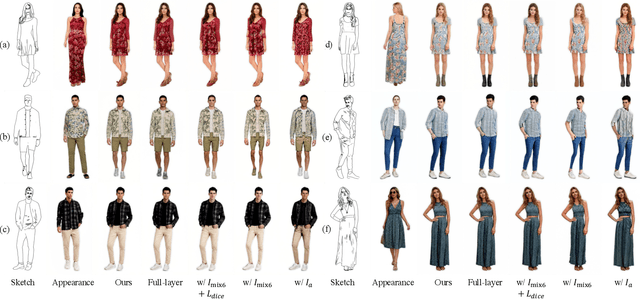
Geometry- and appearance-controlled full-body human image generation is an interesting but challenging task. Existing solutions are either unconditional or dependent on coarse conditions (e.g., pose, text), thus lacking explicit geometry and appearance control of body and garment. Sketching offers such editing ability and has been adopted in various sketch-based face generation and editing solutions. However, directly adapting sketch-based face generation to full-body generation often fails to produce high-fidelity and diverse results due to the high complexity and diversity in the pose, body shape, and garment shape and texture. Recent geometrically controllable diffusion-based methods mainly rely on prompts to generate appearance and it is hard to balance the realism and the faithfulness of their results to the sketch when the input is coarse. This work presents Sketch2Human, the first system for controllable full-body human image generation guided by a semantic sketch (for geometry control) and a reference image (for appearance control). Our solution is based on the latent space of StyleGAN-Human with inverted geometry and appearance latent codes as input. Specifically, we present a sketch encoder trained with a large synthetic dataset sampled from StyleGAN-Human's latent space and directly supervised by sketches rather than real images. Considering the entangled information of partial geometry and texture in StyleGAN-Human and the absence of disentangled datasets, we design a novel training scheme that creates geometry-preserved and appearance-transferred training data to tune a generator to achieve disentangled geometry and appearance control. Although our method is trained with synthetic data, it can handle hand-drawn sketches as well. Qualitative and quantitative evaluations demonstrate the superior performance of our method to state-of-the-art methods.